21 Jun 2026
Regulatory Updates to RNG Protocols Prompt Payout Recalibrations in Licensed Card Gaming Networks

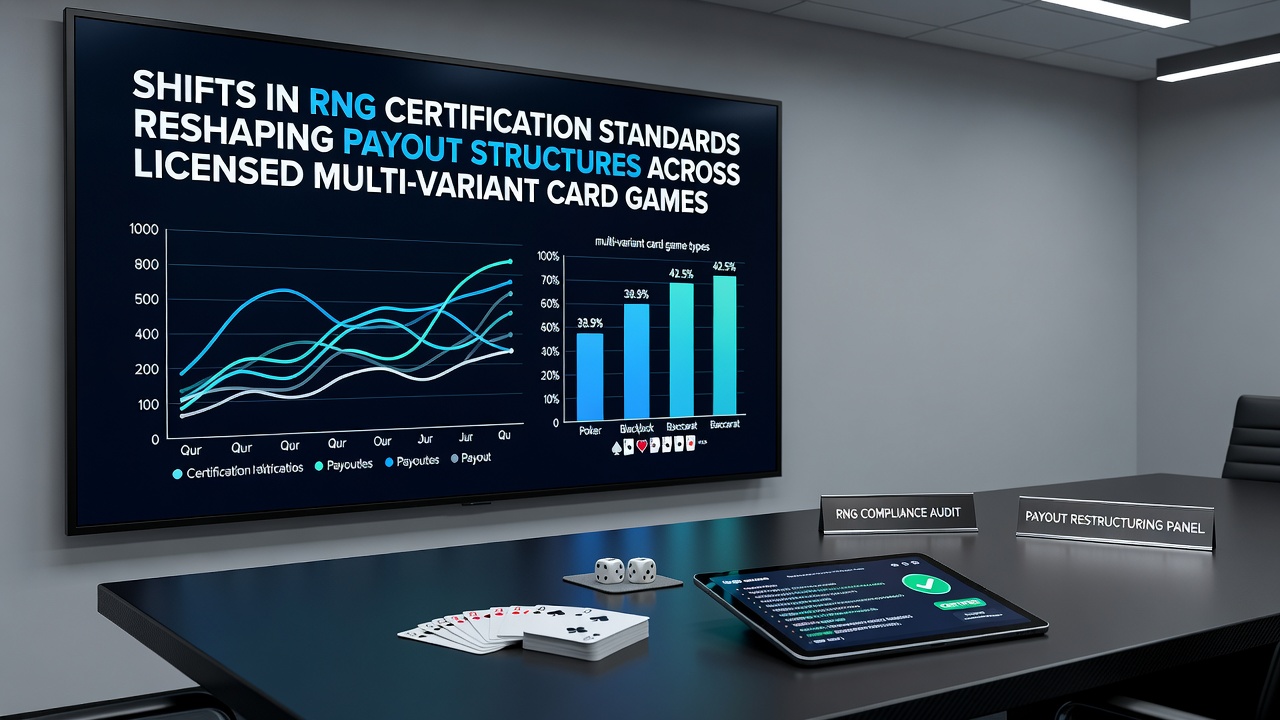
Certification bodies have introduced revised protocols for random number generator evaluation that directly affect how licensed operators calculate returns across blackjack, poker, baccarat and rummy variants on multi-game platforms, and these changes took effect in several jurisdictions during the first half of 2026. Laboratories now require additional statistical testing sequences that verify long-sequence independence under expanded sample sizes, which in turn forces operators to adjust theoretical payout percentages to maintain compliance margins. Data from regulatory filings show that average return-to-player figures on affected titles declined between 0.15 and 0.45 percentage points in markets that adopted teh new standards early.
Operators running integrated card platforms must submit fresh RNG reports that include entropy measurements recorded at multiple clock speeds, and those reports now undergo peer review by at least two accredited labs before approval. The added verification layer extends certification timelines by an average of three weeks, prompting several major networks to freeze new game launches while they complete re-testing cycles. Figures released by the Nevada Gaming Control Board indicate that twenty-seven card titles received updated certifications between March and June 2026, each accompanied by revised payout tables filed with state regulators.
Technical Adjustments Behind the Recalibrations
Revised testing suites demand that RNG outputs demonstrate uniformity across 10^9 draws rather than the previous 10^8 threshold, and this increase compels developers to tighten internal distribution algorithms that feed into payout engines. Because card outcomes derive directly from those sequences, even minor distribution shifts translate into measurable changes in hand-frequency tables used for bonus and side-bet calculations. One study released by the University of Nevada, Reno gaming research unit documented that video poker variants experienced the largest recalibrations, with certain progressive jackpot frequencies lowered to preserve overall return caps mandated by the updated standards.
Multi-variant platforms that host both table and video formats face particular complexity because a single RNG instance often services several games simultaneously. When certification requires separate entropy validation for each variant, operators must either partition RNG streams or accept conservative payout settings that satisfy the strictest requirement across all titles. Industry reports show that partitioned-stream architectures increased server load by roughly 12 percent on average, leading some networks to consolidate game libraries rather than maintain dozens of low-volume variants.
Regional Implementation Patterns Observed Through Mid-2026
North American regulators adopted the new protocols on staggered schedules, with Atlantic City and Pennsylvania completing transition reviews by April while Michigan and New Jersey extended deadlines into July. European authorities aligned through the Malta Gaming Authority issued guidance in February that mirrored the North American technical addendums, although enforcement dates differed by member state. Operators licensed in multiple regions therefore maintain separate payout matrices for the same game titles depending on the jurisdiction where each player account is registered.
Australian states following the framework established by the Northern Territory Racing Commission implemented parallel RNG requirements effective 1 June 2026, and early compliance data indicate that rummy and blackjack hybrids underwent the most frequent payout table revisions. Canadian provinces coordinated through the Alcohol and Gaming Commission of Ontario, which published its updated certification checklist in May; several Ontario-facing platforms adjusted video poker payout schedules within thirty days of the checklist release.
Operational Consequences for Platform Operators
Platform providers responded by deploying dynamic payout engines that reference jurisdiction-specific certification flags at login, allowing a single code base to serve compliant return percentages without maintaining duplicate game builds. This architecture reduces storage overhead yet introduces latency checks that must complete within 150 milliseconds to avoid detectable delays for end users. Internal benchmarks shared at the 2026 Gaming Technology Summit indicated that the added lookup step increased average round-completion time by 4 percent on high-traffic networks.
Third-party auditors now include continuous monitoring clauses in certification contracts, requiring weekly statistical sampling of live RNG output rather than quarterly spot checks used previously. When deviations exceed newly defined tolerance bands, operators must suspend the affected title within twenty-four hours and submit corrective action reports before reinstatement. Several networks reported temporary suspensions of between two and five titles during the initial rollout period, primarily affecting low-volume rummy variants whose RNG streams had not yet accumulated sufficient live data for the expanded testing regime.
Player-Facing Changes and Reporting Requirements
Licensed platforms must display updated theoretical return percentages in help menus and game rules within seven days of certification approval, and regulators in multiple jurisdictions now require that these figures remain visible throughout the entire game session rather than only at the rules screen. Tracking data collected by the New Jersey Division of Gaming Enforcement shows that player inquiries about payout percentages rose 28 percent in the three months following the first wave of revised certifications, prompting operators to add FAQ sections that explain the certification-driven adjustments in plain language.
Bonus and loyalty structures tied to card outcomes also required recalibration because altered hand frequencies affect accumulation rates. Platforms that award loyalty points based on theoretical return therefore adjusted point-earning formulas to preserve parity across titles, while those using fixed-point schedules left earning rates unchanged but modified qualifying game lists. Observers note that these secondary adjustments occurred most frequently on hybrid poker-rummy titles where the same RNG instance drives both game families.
Conclusion
Updated RNG certification standards continue to propagate across licensed card platforms as additional jurisdictions complete their adoption timelines, and operators maintain separate compliance matrices that reflect each regulator's specific testing thresholds. The resulting payout recalibrations remain documented in public regulatory filings, providing transparent records of how certification requirements translate into revised return percentages for multi-variant card environments. Ongoing laboratory monitoring and periodic re-testing cycles ensure that the technical baselines established in early 2026 remain in force through subsequent platform updates.