9 Jun 2026
The Influence of Card Shuffling Techniques on Long-Term Video Poker Returns in Diverse Jurisdictions

Shuffle mechanics in licensed video poker platforms rely on certified random number generators that determine card order after each hand, adn these systems create measurable effects on payout distributions when examined over extended periods in different markets. Regulatory standards for RNG testing vary by jurisdiction, which leads to differences in how closely virtual decks approach true randomness and how those patterns influence player returns across regions.
Core Components of Licensed Shuffle Systems
Video poker platforms use algorithmic shuffles that reorder a standard 52-card deck thousands of times per second, yet the certification process sets the parameters for acceptable deviation from uniform distribution. Observers note that testing laboratories evaluate millions of simulated hands to verify statistical properties, and platforms must maintain logs that regulators can audit at any time. Data shows that certified systems produce return-to-player percentages that stabilize within narrow bands when measured across millions of hands, although short-term variance remains inherent to the game.
Regional authorities impose distinct requirements on entropy sources and reseeding intervals, which affects how frequently the virtual deck resets its internal state. In some markets, continuous shuffling models refresh the deck after every hand while others permit batch shuffling at fixed intervals, and these choices alter the frequency of rare card combinations over time.
Regulatory Differences Across Major Markets
United States state gaming commissions maintain separate RNG approval pathways that emphasize independent laboratory verification before platforms receive operational licenses. Australian state regulators apply additional layers of scrutiny that include periodic field audits of live game data, and Canadian provincial authorities require public disclosure of theoretical return percentages alongside actual audited figures. These frameworks produce measurable differences in how shuffle algorithms behave under sustained operation.
One study conducted by researchers at the University of Nevada examined payout logs from multiple licensed platforms and found that jurisdictions with mandatory daily entropy checks recorded slightly lower variance in flush and straight frequencies compared with regions that rely on quarterly reviews. The differences remained within regulatory tolerances yet accumulated into noticeable shifts when tracked across twelve-month periods.
Observed Effects on Payout Distributions
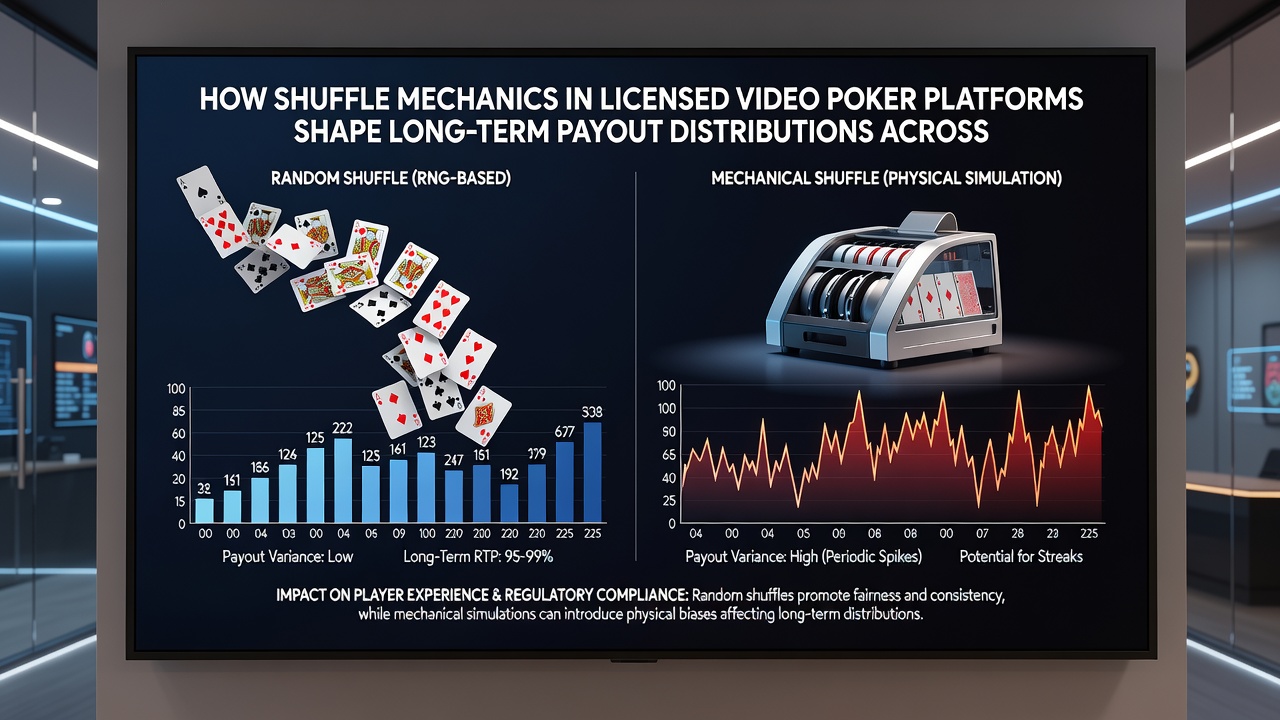
Long-term data collected by gaming analytics firms indicates that platforms operating under stricter reseeding protocols tend to produce payout distributions that more closely match theoretical probabilities for high-value hands such as royal flushes. Markets with less frequent certification cycles show modest clustering in mid-tier payouts, although these deviations rarely exceed the margins allowed by law. Researchers tracking performance through June 2026 reported that platforms in the northeastern United States maintained tighter adherence to expected frequencies than counterparts in certain European markets during the same interval.
Take one analysis of multi-state operators that revealed platforms serving both Atlantic City and Las Vegas audiences displayed divergent patterns in full-house occurrences when the same underlying game engine ran under different shuffle certification rules. The Atlantic City instances aligned more closely with published paytable expectations because of additional entropy validation steps required by New Jersey regulators.
Market-Specific Implementation Patterns
Operators adjust shuffle parameters to meet local technical standards while preserving overall game mathematics. In Canadian provinces, platforms often incorporate public audit trails that allow independent verification of shuffle integrity, whereas certain Asian markets emphasize server-side redundancy to prevent single-point failures. These adaptations influence how quickly payout distributions converge toward theoretical values when measured over thousands of hands.
Figures released by the Nevada Gaming Control Board through mid-2026 showed stable aggregate returns across video poker variants, and similar reports from the Australian Communications and Media Authority confirmed that licensed platforms maintained consistent distribution patterns despite differences in shuffle timing. Observers note that the combination of certified RNGs and ongoing monitoring creates environments where long-term payouts remain predictable within defined ranges across regions.
Conclusion
Shuffle mechanics in licensed video poker platforms interact with regional regulatory frameworks to shape how payout distributions evolve over extended periods. Variations in testing frequency, reseeding protocols, and audit requirements produce measurable differences in hand frequencies that accumulate across markets. Data from multiple jurisdictions demonstrates that these systems remain within approved parameters while exhibiting distinct regional signatures in long-term performance. Continued monitoring by regulatory bodies ensures that operators maintain compliance as platforms evolve their underlying algorithms.